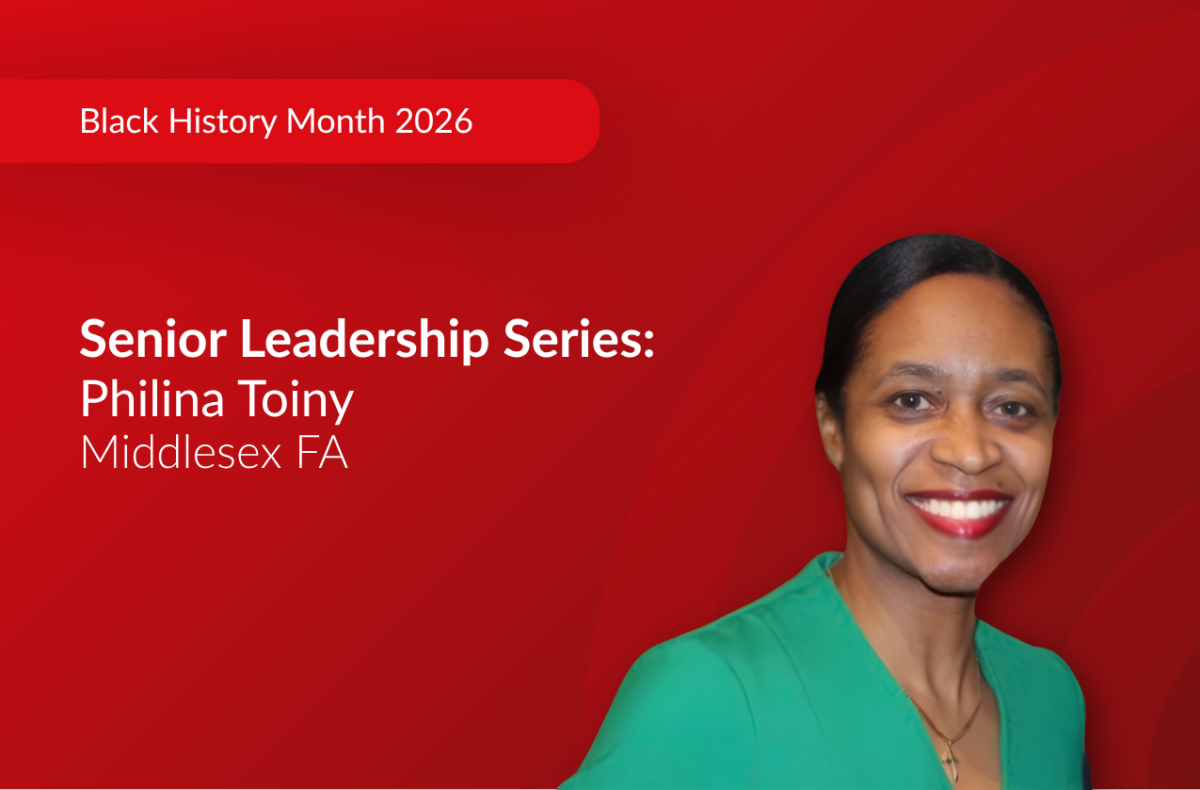
By GatenbySanderson | Black History Month 2026, Leadership Series. Rebecca Hopkin, Sport Practice Interview with Philina Toiny, Chair of Middlesex FA, Council Member of Birmingham Newman University, Committee Member of Karibu Community Homes and Director of Peridot Management Solutions.
For Black History Month 2026, we’re bringing together a select group of senior leaders for a short interview series titled: Honouring Our Communities: Leadership, Representation and Legacy.
Inspired by this year’s Black History Month theme, the series explores the role leadership plays in building inclusive organisations, celebrating community contributions, and creating opportunities for future generations. Rather than focusing solely on organisational achievements, our interviews aim to capture reflections on leadership, representation, community impact, and the lessons that have shaped leaders throughout their careers.
In this edition, we speak with Philina Toiny, Chair of Middlesex FA, Council Member of Birmingham Newman University, Committee Member of Karibu Community Homes and Director of Peridot Management Solutions, about inclusive leadership, the influence of her Caribbean heritage and her parents’ Windrush experience, transformation, coaching and creating environments where different perspectives can thrive.
1. “Can you give an example of how you have strengthened inclusion, representation or community engagement?”
Inclusion is very important to me because I genuinely believe our differences make us better. When you bring together people with different experiences, cultures, perspectives and ways of thinking, you get a richness of thought that can lead to better personal and professional outcomes.
That belief has been reflected throughout my career. In corporate environments, I have worked as a Financial Inclusion (in the community e.g. inner city schools; Cost of Living Survey) Lead and an Inclusion Lead, looking not only at how resources are managed, but also at how we treat colleagues and clients and whether people have a genuine opportunity to contribute and succeed.
It has been equally important in my purpose-led and not-for-profit work. Through roles with Middlesex FA, Karibu Community Housing, Birmingham Newman University and Sported UK, as well as working as a Volunteer Coach and providing guidance to others, I have tried to use my experience to create opportunities and support people to fulfil their potential.
My own Caribbean heritage and my parents’ experience as part of the Windrush generation have also shaped this. Education was particularly important in my family because my parents saw it as a means of creating opportunity and enabling the next generation to contribute.
For me, inclusion is therefore not just about representation. It is about recognising the value that difference brings and creating an environment where people can contribute, develop and thrive.
2. “How have your lived experiences influenced your leadership?”
I was raised within a very inclusive family setting where many different cultures were celebrated. My parents came to the UK from the Caribbean to study and work as part of the Windrush generation, and education was always seen as extremely important.
Growing up in that environment made me very accepting of difference and curious about what different people bring to a community. It taught me that there is not necessarily one “right” way of doing something.
That has had a significant influence on my leadership style. I believe everyone should be given opportunities and supported to reach their full potential, even where their approach, background or way of thinking may be unconventional.
I often use the phrase “there are many ways to crack a nut.” For me, that means being open to different approaches rather than assuming that my way is the only way.
As a leader, I therefore try to understand what enables each individual to perform at their best. That does not mean lowering standards. Quite the opposite—it means recognising different strengths and creating the conditions for people to use those strengths effectively.
3. “Can you describe a decision where inclusion was an important factor, but not the only consideration?”
One example comes from my experience with the Professional Women’s Network, where I served as President and then worked in a Co-President leadership model.
When you lead a professional network across different cultures, countries and professional backgrounds, you quickly recognise that there are many ways of doing things and that different leadership styles can be equally effective.
The decision to work collaboratively through a Co-President model meant recognising that leadership did not have to be centred around one person’s style or approach. We brought different perspectives and leadership strengths together, while still having to consider the organisation’s strategy, governance, growth and operational effectiveness.
That experience reinforced something important for me: inclusion does not mean that everyone has to think or lead in the same way. It means creating enough space for different approaches to contribute to a common objective.
The outcome was a stronger leadership model because we were able to draw on complementary perspectives and styles rather than trying to make everyone conform to one way of working.
4. “Can you tell us about a time you got something wrong or changed your approach?”
As a Transformation Leader, I have learned that change rarely happens exactly as you originally envisage it.
I am very comfortable changing my approach. In transformation, I often use proof-of-concepts and experimentation because I believe in the principle of “fail fast, learn faster.” The important thing is that failure is controlled, that you learn from it and that the learning informs what you do next.
My consulting career has reinforced that approach. When working with clients, solutioning is often about ideation-bringing different perspectives together, testing possibilities and finding the most appropriate route through a complex problem.
I apply the same thinking personally. When making an important decision, I consider the potential outcomes, test my assumptions and think about what might happen next. If the evidence tells me that another path is better, I am comfortable changing direction.
For me, changing your approach is not a weakness. The ability to listen, learn and adapt is an important leadership strength.
5. “What have you learned from a colleague, mentor, community or historical figure?”
Three things that have stayed with me are resilience, humility and having a social conscience.
My parents’ experience is an important part of that. Coming from the Caribbean to the UK as part of the Windrush generation, they had to adapt, work hard and build opportunities for themselves and their family. Education was central to that journey and to the values they passed on to me.
They taught me that success should never be viewed purely as an individual achievement. There is a responsibility to use your experience and opportunities positively and to contribute to the communities around you.
That is something I have carried into my professional life and particularly into my Board and voluntary work.
I have also learned humility from working with people in very different circumstances—whether young people in sport, community organisations, colleagues, clients or fellow Board members. You can learn something from everyone if you are prepared to listen.
6. “How do you prevent inclusion from being deprioritised when an organisation is under pressure?”
For me, inclusion has to be at the heart of how an organisation works, rather than being something that is added when circumstances allow.
A lot of my career has been about transformation, and I have learned that successful transformation is ultimately about people and culture. You can design the best strategy, operating model or technology solution in the world, but if you do not understand how it affects people, you are unlikely to deliver sustainable change.
One of the things I consciously try to do is put myself in other people’s shoes. I ask: What does this decision look like from their perspective? What barriers might they experience? Whose voice haven’t we heard?
That way of thinking has become particularly important in my approach to ways of working, culture and change leadership.
When an organisation is under pressure, those considerations become even more important because the impact of decisions can be greatest on people who have the least influence.
So I do not see inclusion and performance as competing priorities. Good inclusive leadership helps organisations make better decisions, manage change more effectively and achieve better outcomes.
7. “What leadership behaviour have you changed that has made the biggest impact?”
I would say that my leadership has increasingly evolved towards a considered coaching style.
Earlier in my career, particularly working in transformation and consulting, there was often a strong emphasis on providing answers, setting direction and getting things done. As my experience has developed, I have become much more conscious of the value of coaching—helping people find their own answers, develop their confidence and take ownership.
I see coaching as a two-way relationship. It isn’t simply about what I can give to the person I am coaching. I also learn from the coachee – their perspective, experience, questions and way of seeing the world.
That has made me a better leader because it has reinforced the importance of curiosity and listening.
It also connects strongly with my belief in inclusion. If I genuinely believe that different perspectives make us better, then I have to create the space to hear those perspectives.
My leadership continues to evolve because every person I work with teaches me something.
Read more from our Black History Month Leadership Series
Explore more conversations from Honouring Our Communities: Leadership, Representation and Legacy, including our interview with Chantelle Brown on inclusive leadership, representation and creating opportunities for future generations
Speak to GatenbySanderson about building diverse and inclusive leadership teams:
Rebecca Hopkin, Sport Practice