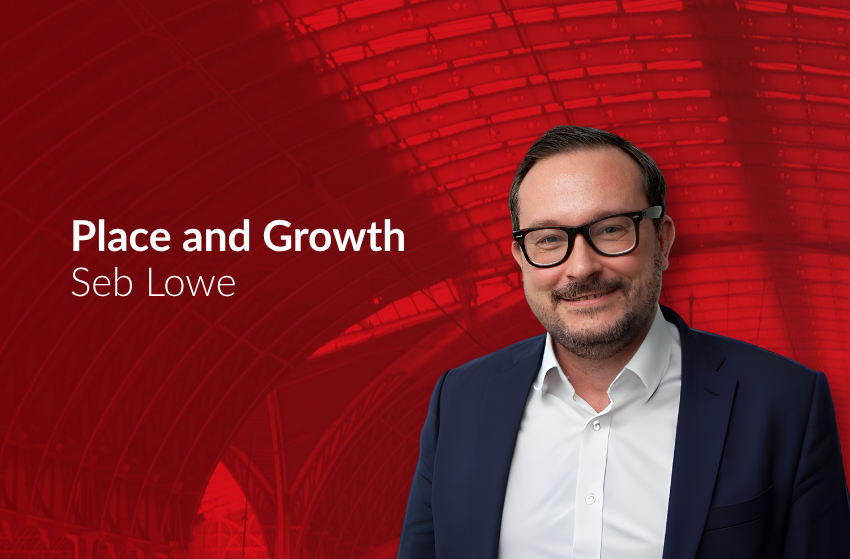
By Seb Lowe, Partner, Place & Growth at GatenbySanderson.
For much of the past two decades, “place” has been one of the most frequently used concepts in UK economic policy. Yet increasingly, place is no longer an abstract idea defined by strategies and aspirations. It is being judged by something far more tangible: delivery.
Success is measured through new homes, regenerated town centres, transport infrastructure, employment opportunities and investment flowing into communities. As a result, the debate about regional growth is shifting. The question is no longer whether places have a vision for growth. It is whether they have the capability to turn that vision into reality.
This marks an important moment for Combined Authorities and regional institutions, as devolution has matured, expectations have grown alongside it. Developing strategy and convening partners remain essential functions, but they are no longer sufficient on their own. Increasingly, regional institutions are expected to unlock investment, coordinate delivery and create the conditions for long-term economic growth.
From Control to Orchestration
The challenge is that growth is rarely within the control of any single organisation. Delivery depends on a complex network of local authorities, developers, investors, infrastructure providers, transport bodies and anchor institutions, each operating with different priorities and incentives. In this environment, success depends less on directing activity and more on orchestrating it.
The regions making the strongest progress recognise this distinction. They understand that growth cannot be commanded through governance structures alone. Instead, they focus on creating alignment around a shared vision, building confidence in long-term delivery and bringing together public and private interests behind common objectives. Leadership becomes critical not as an expression of authority, but as the ability to create coherence across a complex system.
The Importance of Strategic Choice
At the same time, growth strategies are becoming sharper and more selective. In an era of constrained public finances and increasingly competitive investment markets, regions can no longer pursue every opportunity simultaneously. Difficult choices are unavoidable. Leaders must decide where growth should be concentrated, which sectors offer the greatest long-term value and which investments will unlock wider economic benefits.
The places generating the greatest momentum are often those that have moved beyond broad ambitions towards a clear and compelling proposition. They can articulate where growth will happen, why it matters and how delivery will be achieved. That clarity creates confidence amongst investors, delivery partners and communities alike.
Turning Vision into Investment
This is particularly important as the relationship between regional institutions and the market continues to evolve. Investors still value vision, but they increasingly look for evidence of deliverability. Ambition alone is rarely enough. Confidence is built through credible governance, clear infrastructure plans, development-ready opportunities and realistic delivery pathways. The most successful places are therefore distinguished not simply by the quality of their strategies, but by their ability to convert strategic ambition into investable propositions.
Yet even where ambition and investment exist, growth can still be undermined by fragmentation. One of the most persistent challenges facing places today is the gap between individual policy areas. Housing, transport, infrastructure, skills and economic development are often planned and delivered through separate systems, despite being deeply interconnected. The consequence is that activity can be abundant, but outcomes remain suboptimal.
Growth as a Systems Challenge
The strongest regional leaders understand that place-based growth is fundamentally a systems challenge. Their role is to connect decisions that would otherwise be made in isolation, ensuring that housing growth is supported by transport investment, that infrastructure anticipates future demand and that skills provision aligns with emerging employment opportunities.
This requires a different kind of leadership capability and increasingly, the constraint on growth is not ambition, It’s capacity. Delivering complex regeneration and development programmes requires commercial expertise, delivery discipline, strategic insight and the ability to build trusted relationships across multiple organisations. Few of these capabilities sit neatly within a single institution.
As a result, the most forward-looking regions are focusing less on individual leaders and more on the capability of the wider system. They are investing in the structures, partnerships and leadership capacity needed to sustain delivery over the long term.
The Leadership Imperative
That long-term perspective is essential, place-based growth unfolds over decades, not electoral cycles. Political priorities change, funding environments shift and leadership teams come and go. The regions that succeed are those that build institutions and partnerships capable of maintaining momentum through periods of change. They recognise that leadership is not simply about setting direction. It is also about stewardship, consistency and sustaining confidence over time.
Ultimately, the next phase of devolution is unlikely to be defined by further institutional reform alone. The UK has made significant progress in creating the structures necessary for regional growth. The more pressing question is whether places can fully exploit the opportunities those structures already provide.
In that context, leadership is emerging as the decisive factor. It is what connects vision to delivery, investment to outcomes and strategy to lasting economic change. The places that thrive in the years ahead will not necessarily be those with the most ambitious plans. They will be those with the leadership capability to turn ambition into outcomes that are tangible, investable and enduring.
About the Author
Seb Lowe is Partner, Place & Growth at GatenbySanderson, working with Combined Authorities, development corporations and growth partnerships to identify and develop the leaders responsible for delivering regeneration, investment and long-term place outcomes.
GatenbySanderson’s Place & Growth Leadership practice supports organisations across executive search, interim leadership and leadership development, helping build the leadership capability required to deliver regeneration, economic growth and lasting place outcomes.
Learn more: https://www.gatenbysanderson.com/sector-expertise/local-government/place-growth/