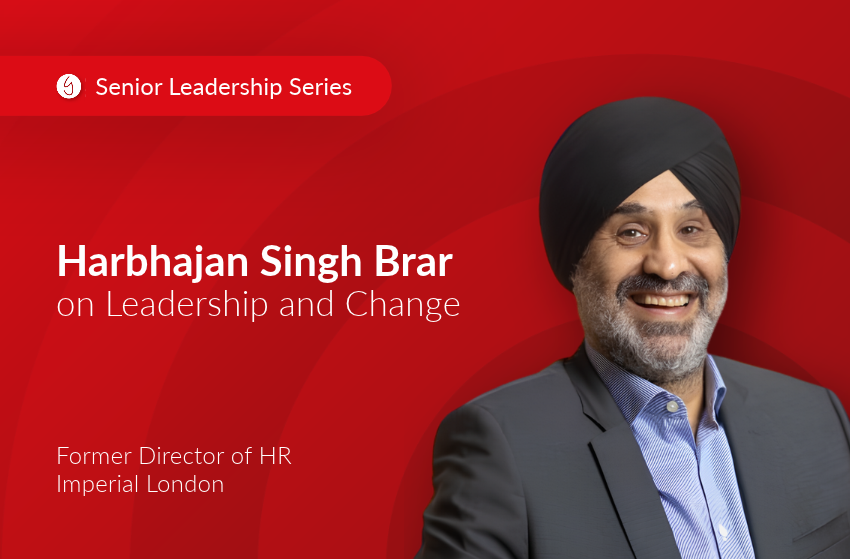
By GatenbySanderson | Leadership Series. Interview by Robin Staveley OBE with Harbhajan Singh Brar, former HR Director at Imperial College London.
We’re bringing together a select group of senior leaders for our interview series on leadership, values and organisational change.
As part of the series, I took the opportunity to meet Harbhajan Singh Brar and talk to him about his career, with a particular focus on some of the key moments and the people who guided and inspired him along the way. Our conversation coincided with Harbhajan having recently retired from his last executive role as HR Director for Imperial College London, so it felt like a good moment to reflect.
Harbhajan’s career to date has incredible breadth to it. And yet it starts with a placement at the London Borough of Ealing as part of a Lancaster University postgraduate diploma. The ingredients that allowed this step to lead to such an interesting career were fascinating to learn about. A seed had been planted in Ealing. Hearing about what was added to that seed made for a fascinating hour’s discussion.
Through our conversation, it was evident that Harbhajan feels he has benefited from the guidance and advice of a few key individuals. But I think he also demonstrated a consistent personal focus on improving organisational performance through people, culture, fairness and practical problem-solving. His examples ranged from equality and workforce reform initiatives in local government through to leading hospital turnarounds, major workforce transformations and large-scale organisational change. His own sense of right and wrong, and his determination to tackle the latter, is an important ingredient in his career.
Here are a few of the things that stayed with me.
1. Values-driven leadership
Harbhajan’s career has been strongly influenced by a commitment to fairness, inclusion and achieving more equitable outcomes. This was evident from his earliest work on recruitment equality through to later leadership positions across healthcare, government and education. One example we discussed came from early in his career. Harbhajan saw shortcomings in the recruitment processes of the very diverse London borough where he was working, so he wrote a report. That report led to an independent inquiry and was subsequently published. In turn, it led to significant changes to the Council’s recruitment process, which improved the diversity of hires. It is a good example of something that came up throughout our conversation: seeing something that could be better and being prepared to do something about it.
2. Balancing strategic thinking with a practical approach
While Harbhajan values research, policy and long-term planning, he realised early in his career that hands-on roles were more “his thing”. His eyes light up when he talks about implementation, solving real-world problems such as workforce and organisational change, and achieving meaningful and impactful outcomes. That combination of strategic thinking and practical delivery came up several times during our conversation. It seems to me to be one of the strengths that has allowed him to move between very different organisations and sectors throughout his career.
3. Visibility and engagement
Harbhajan repeatedly emphasised staying close to frontline staff, understanding operational realities and building solutions from the bottom up. This seems to have been a consistent feature of how he approached both transformational and turnaround roles. It is perhaps no surprise that former colleagues have subsequently headhunted him to help deliver significant change programmes. There is something quite simple in that approach: whatever your position in an organisation, you need to understand what is actually happening within it and listen to the people doing the work.
4. The breadth of his career
Harbhajan has charted a career path that weaves its way across local government, the NHS, the Civil Service, higher education and private industry. There is, though, a common thread running through those increasingly complex roles: creating positive impact by working to understand organisational dynamics. I also picked up several references to the balance between strategy and operations that he strikes. It seems to me to be a particular strength and certainly formed a golden thread through our conversation. Perhaps that breadth has also given Harbhajan something valuable: experience of seeing similar organisational challenges through very different lenses.
5. Guidance
Key people, some quite early in his working life, have nurtured and shaped Harbhajan’s career. One in particular seems to have been somebody Harbhajan would turn to as a coach, mentor and probably friend, but also somebody who could challenge his thinking. Two names came through particularly strongly: Ruth Silver at Lewisham College, who took a risk and gave Harbhajan his first Director break, and Kwame Akuffo at Ealing, who became his friend and mentor. My reflection on this is that Harbhajan is quick to acknowledge their impact. In some ways, he seeks to share his career success with them and, in doing so, to thank them. My guess is that his impact on others around him will have been as great, if not greater. I suspect there is more to come here too, as he steps more fully into a portfolio career.
6. Faith
I cannot conclude these reflections without reference to Harbhajan’s faith and its role in shaping his approach to work. This is, of course, a private matter, but I hope it is accurate to say that it quietly plays a central role in how he approaches his work, the decisions he makes and the way he works with others. It felt connected to many of the other themes we discussed, particularly fairness, values and his determination to have a positive impact.
More than a career in HR
At the end of the interview, one reflection I had was that we had not really discussed Harbhajan’s “career in HR”. HR became his professional area almost by accident and, in many ways, seems to have served a wider purpose: a vehicle for Harbhajan to have a positive impact.
The interview was as much about the impact of a few people on his life and career. Ruth Silver at Lewisham College, who took a risk and gave him his first Director break, and Kwame Akuffo at Ealing, who became his friend and mentor, to name just two. And it was about Harbhajan’s impact too: whether at HMP Northumberland with Sodexo, Barnet and Chase Farm Hospital in the NHS, the Department of Health or Lewisham College.
That is quite the impact from that postgraduate placement in Ealing.
As Harbhajan’s portfolio career develops, his impact on others has an interesting journey ahead. The one strong probability is that it will not be a predictable, well-trodden path.
Read our Black History Month Leadership Series
Explore more conversations from Honouring Our Communities: Leadership, Representation and Legacy, including our interview with Chantelle Brown on inclusive leadership, representation and creating opportunities for future generations
Speak to GatenbySanderson about building diverse and inclusive leadership teams:
Contact our team.