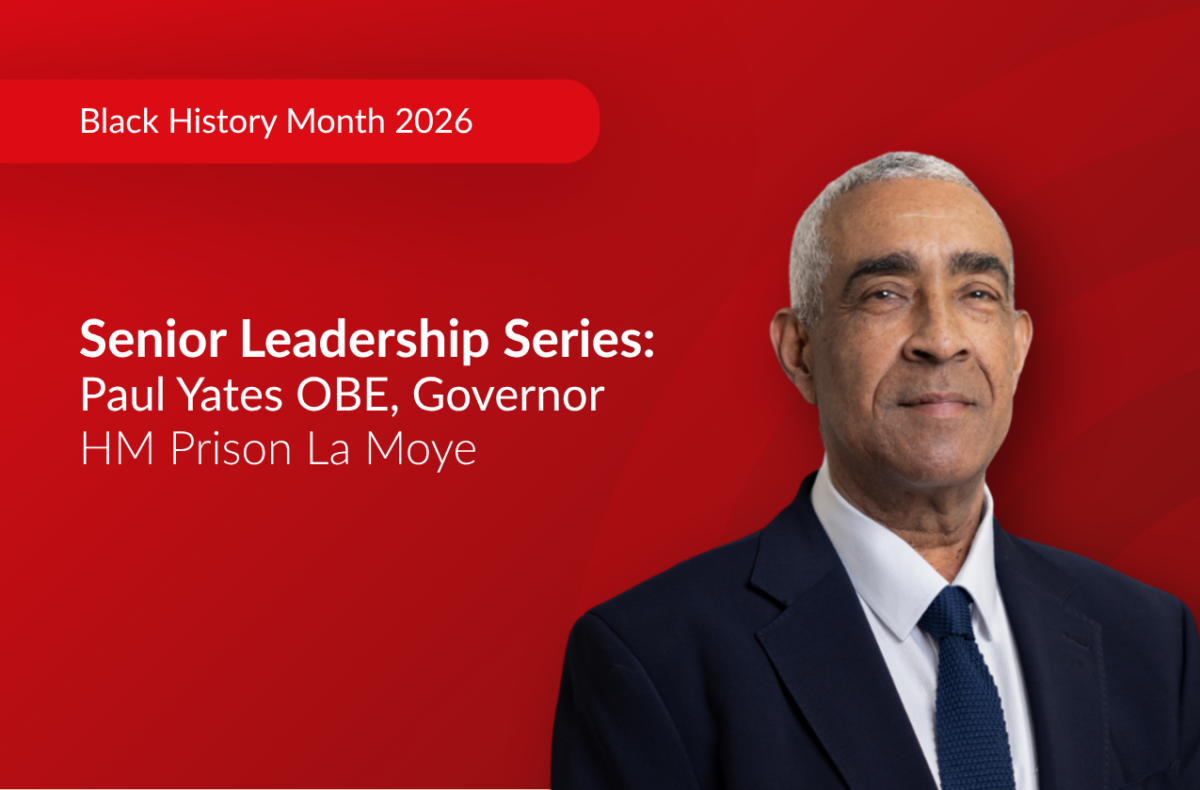
By GatenbySanderson | Black History Month 2026, Leadership Series. Central Government Practice Interview with Paul Yates OBE, Governor, HM Prison La Moye
For Black History Month 2026, we’re bringing together a select group of senior leaders for a short interview series titled: Honouring Our Communities: Leadership, Representation and Legacy. Inspired by this year’s Black History Month theme, the series explores the role leadership plays in building inclusive organisations, celebrating community contributions, and creating opportunities for future generations. Rather than focusing solely on organisational achievements, our interviews aim to capture reflections on leadership, representation, community impact, and the lessons that have shaped leaders throughout their careers.
In this edition, the Central Government team at GatenbySanderson, speaks with Paul Yates OBE, Governor of HM Prison La Moye, about representation, community, learning from different lived experiences and the importance of listening. Drawing on his career across prisons and probation, Paul also reflects on the experiences that have shaped his own approach to leadership.
1. Can you share an example of a decision or initiative that helped to strengthen inclusion, representation, or community engagement within your organisation?
One thing I have learned over many years, certainly through my experience in prisons and probation, is that we are a community within a community. We not only serve the community but also need the community’s help to do the work we do. Our prison population generally reflects the wider community, although some groups are disproportionately represented, so we need communities outside the prison system to help us understand and support the people within it.
Faith communities are a good example. I am not particularly religious myself, but I recognise how important faith can be in custody and how valuable those connections can be for staff too. At Nottingham, for example, we saw an increase in Nigerian staff, some of whom had never been to the UK before. We approached the local Nigerian community to help with integration, friendship, and finding places where those new staff would feel supported. It became almost part of their induction into life in the UK.
It also created opportunities for those colleagues to share their own experiences. Wherever we come from in the world, we often have far more in common than we realise. Many cultures have an oral tradition of stories and conversation, and there is something universal about getting people together to talk and share food. Those simple things can be incredibly important in bringing people together.
Over the years, I have also become more conscious that seeing somebody who looks like me in the position I hold can have an impact. I have never set out to be a role model, but I recognise that representation matters and that I have a responsibility to make sure the impact I have is a positive one. Ultimately, this is a people job. My favourite part of it is getting out, walking around and talking to people, because that is where you learn.
2. How has learning from different lived experiences influenced your approach to leadership?
It is almost impossible for it not to. I was fortunate enough to do some work with the HM Prison and Probation Service international team, working with other countries to support their prison systems. One experience in Bahrain has particularly stayed with me.
We were visiting a prison where the accommodation was largely communal. Coming from the UK system, we asked some of the prisoners whether they would prefer to have their own accommodation, and they looked at us as though it was a very strange question. We did not think too much about it at the time. Later that week, however, we had the privilege of visiting a traditional family home and realised that the way the rooms were laid out was very similar to the accommodation we had seen in the prison.
It suddenly clicked. In England, having your own cell might be seen as something desirable, whereas in a Bahraini prison, being on your own could actually be seen as a punishment. People were used to being together in their family homes and that sense of community continued in prison. It was a really useful reminder to suspend judgement and recognise that our own expectations of what is “good” are not necessarily the same as somebody else’s.
That experience also influenced some of my thinking back in the UK. At Lincoln, for example, we introduced tables on the wings to encourage prisoners to sit down together and have their dinner rather than simply taking their food back to their cells. I have been fortunate to spend time in Ghana, Bahrain, Jamaica and Barbados, and every experience presents an opportunity to learn. Taking the time to stand still and listen is such an important skill. There will always be cultural differences and different norms, but we need to be open to understanding them rather than assuming our own experience is the default.
3. Can you describe a decision where inclusion was an important factor, but not the only consideration?
In a couple of the prisons I have worked in, we had significant traveller communities. Understanding how to communicate and engage with those communities was really important. There could also be differences between older and younger members of the community, so we needed to understand who to speak to and how best to engage them.
At one point, we were dealing with issues around behaviour, engagement with the prison regime and, importantly, reducing violence. We needed to find a way of starting a different kind of conversation, and food became part of that. We began asking people about the food they wanted to cook and eat together. Some of the things they asked for were not what you would normally find within the prison menu system, so we had to look at what we could realistically source and provide.
The purpose was not simply about food or inclusion. The wider priority was improving behaviour, increasing safety and reducing violence, but food gave us a mechanism for bringing people together and getting them talking. Sometimes finding that common denominator changes the nature of the conversation. It helped us engage with people in a different way, while still working towards the wider outcomes we needed to achieve.
4. Can you tell us about a time you got something wrong or changed your approach?
One experience that stayed with me involved discovering that staff in a prison I was leading had effectively created a food bank. I received a call about it and initially knew nothing about it. It turned out there was a large cabinet in an area I walked past every day where staff were very discreetly donating food for colleagues who were struggling financially.
What struck me was how discreetly people were supporting each other. There were staff coming to work every day who, for all sorts of reasons, still needed help to feed their families. I felt that if colleagues had quietly decided to look after each other in that way, it was something I should support.
Where it became more difficult was when the existence of the food bank moved into a political context during a period of discussion around salaries. I spoke quite openly about supporting what staff were doing, but professionally the issue had moved into a different space and there was the potential for my comments to cause embarrassment to ministers. I subsequently had to apologise.
Did I get it right or wrong? I still believe supporting those colleagues was the right thing to do, but I learned something about the broader responsibilities that come with being in a senior leadership position and the different contexts in which your words can be interpreted. There was also a much wider lesson for me: we should never assume we understand somebody’s circumstances simply because they come to work every day in a full-time job. Creating an environment where people look out for and support one another matters.
5. What is one lesson from a colleague, mentor, community leader or historical figure that has shaped the way you lead today?
Barack Obama is someone who has made me stop and pay attention. There is something about the way he speaks and engages with people that I find incredibly inclusive. Whatever somebody’s history, heritage, gender or background, you still need to be able to speak to them, but there is also a real art to listening. That ability to stop, pay attention and listen is something that has stayed with me.
I have also learned a great deal from the coaches and mentors I have had at different stages of my career, but sponsorship has been particularly important. Earlier in my career, I had a senior leader who was advocating for me in different environments. I did not necessarily know it was happening at the time, but later I realised that there were people in my corner, supporting me and putting my name forward when I was not in the room.
As I became more senior, I started to recognise my own responsibility to do that for other people. Sponsorship does not have to be a formal process. Sometimes it is as simple as being in a meeting when somebody asks who could take on a piece of work and saying, “She would be amazing at that.” When you are in a senior position, you have opportunities to recognise talent and support people who may not yet recognise how good they are themselves. I like to think I am good at spotting talent, and I see that as part of the responsibility of leadership.
I am also increasingly conscious of the importance of preserving the stories within our own families and communities. I have been trying to encourage my sons to interview their grandmother and record her experience of coming to the UK from the Caribbean in the 1960s. She has always been there, so it is easy to assume she always will be, but those experiences and that history need to be heard. Racism today can look very different from the racism experienced in the 1950s, 60s or 70s, which makes listening to those stories and understanding that history all the more important.
6. How do you prevent inclusion from being deprioritised when an organisation is under pressure?
You have to talk about it, and you have to prioritise it, it needs to be part of the normal, everyday conversation rather than something separate. We have to keep asking the questions: why does this matter, what benefits does it bring and what value does it add?
Representation is an important part of that because people need to see people who look like them within organisations and at senior levels. I do not believe recruitment decisions should simply be made based on somebody’s gender or race. You still want the best person for the job. But there is real value in organisations having people at senior levels who reflect those who work within them and the communities they serve. That can help people feel that they belong and see opportunities for themselves.
At times, I have underestimated the impact of simply walking into a room. I have seen the look on people’s faces when they were not expecting somebody who looks like me to be holding the position I hold. That visual representation can be significant. I can remember seeing black people on television when I was young and noticing it precisely because it was unusual. Seeing somebody who looks like you can affect what you believe is possible. That is also why I think these conversations cannot only take place in October.
Black History Month is an important moment, but representation and inclusion have to be part of how organisations think and operate throughout the year.
7. What leadership behaviour have you changed that has made the biggest impact?
One thing I learned relatively early in my career was the importance of understanding how presentation can affect the way people respond to you. When I was training, one of our tutors told us that we needed to wear suits. At the time I questioned why, but I realised quite quickly that people often make judgements based on how you present yourself.
For me, as a black man, my suit became almost like armour. I realised that people would sometimes treat me differently when I had a suit on than when I did not. They would see the suit first. I believe people should have the freedom to express themselves, and different workplaces and cultures have very different expectations around dress, but I learned that dressing for the occasion can affect the way people perceive and respond to you. It probably should not, but it does.
That lesson evolved for me through another experience. I was once interviewing somebody for a promotion and found myself distracted by what they were wearing. I suddenly realised that I had missed much of their first two answers because I had been thinking about their clothes rather than concentrating on what they were telling me.
I remember being cross with myself because they had not distracted me; I had allowed myself to be distracted. It taught me that somebody has the right to come to an interview dressed however they choose, and my responsibility is to listen to their words, their experience and what they can bring. That is far more important than my own reaction to how they choose to present themselves.
Read more from our Black History Month Leadership Series
Explore more conversations from Honouring Our Communities: Leadership, Representation and Legacy, including our interview with Chantelle Brown on inclusive leadership, representation and creating opportunities for future generations
Speak to GatenbySanderson about building diverse and inclusive leadership teams:
Contact the Central Government team.