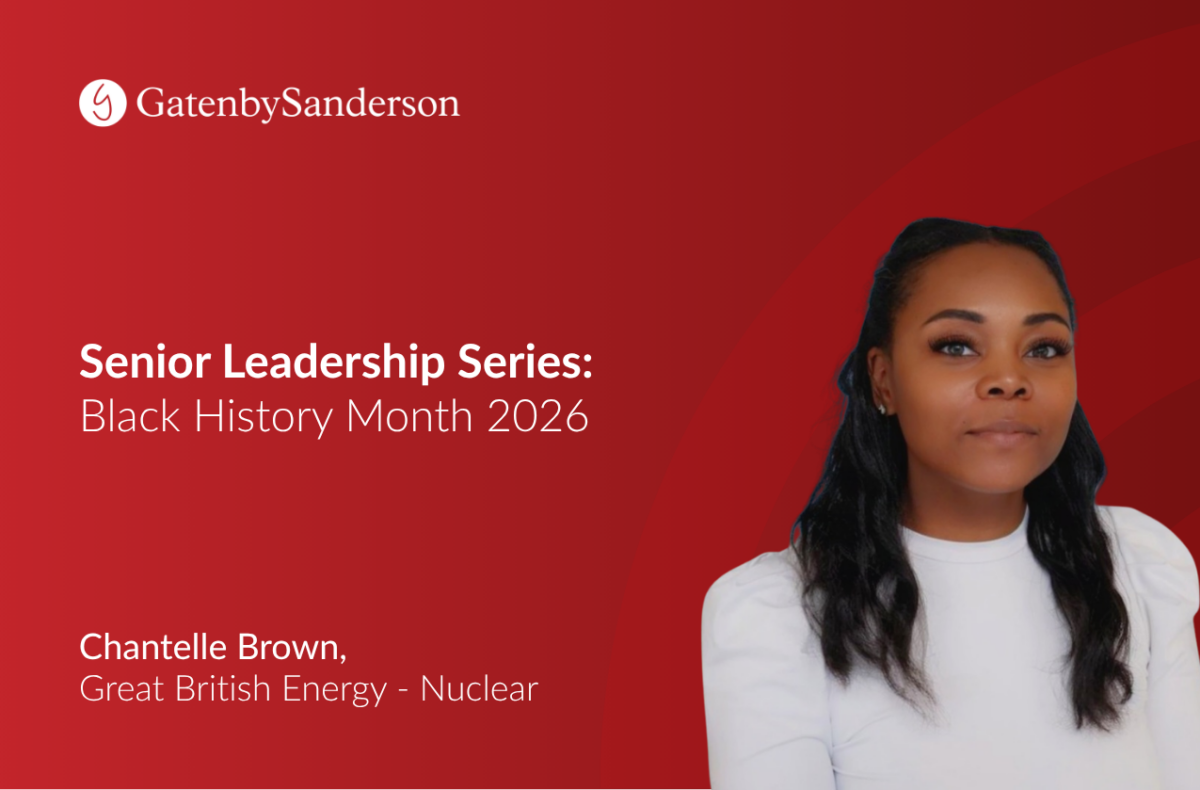
By GatenbySanderson | Black History Month 2026, Leadership Series. Interview by Darra Power-Mooney, Energy Sector with Chantelle Brown, Head of Talent Attraction, Diversity & Inclusion: Great British Energy – Nuclear and Operations Delivery Lead – Women in Nuclear.
For Black History Month 2026, we’re bringing together a select group of senior public sector leaders for a short interview series titled: Honouring Our Communities: Leadership, Representation and Legacy.
Inspired by this year’s Black History Month theme, the series explores the role leadership plays in building inclusive organisations, celebrating community contributions, and creating opportunities for future generations. Rather than focusing solely on organisational achievements, our interviews aim to capture reflections on leadership, representation, community impact, and the lessons that have shaped leaders throughout their careers.
In this edition, Darra Power-Mooney, GatenbySanderson, speaks with Chantelle Brown, Head of Talent Attraction, Diversity & Inclusion: Great British Energy – Nuclear, and Operations Delivery Lead – Women in Nuclear, about inclusive leadership, representation in the nuclear sector, reverse mentoring and the importance of embedding diversity and inclusion into organisational decision-making.
1. “Can you share an example of a decision or initiative that helped strengthen inclusion, representation, or community engagement within your organisation?”
One initiative I’m particularly proud of is establishing GBE-N’s reverse mentoring programme. It started as a pilot in January, and for me it was important that it wasn’t simply another initiative, but something that created a genuinely safe space for honest conversations. We paired members of our Executive Team with graduates, giving our early career colleagues a direct opportunity to share their experiences and perspectives, while giving senior leaders the chance to listen, learn and see the organisation through a different lens.
What I particularly value about reverse mentoring is that it challenges the idea that learning only flows from the most senior person in the room. Our graduates brought fresh perspectives on leadership, culture, inclusion and what it feels like to start a career at GBE-N. We paired people from outside their own directorates so they could build relationships across the organisation and have conversations they might not otherwise have. I wanted our graduates to know from the outset that their voices matter and that they can influence how we think and lead.
The pilot really showed us the value of getting those different generations and experiences talking openly. Feedback was overwhelmingly positive, and I was particularly pleased to see graduates growing in confidence and leaders reflecting on their own approaches. For me, that’s what inclusion should feel like in practice: people learning from one another, challenging assumptions and being genuinely curious about experiences different from their own.
I’m proud that the pilot has now given us something we can build on. We are launching our second cohort in October, and the intention is for reverse mentoring to become an annual programme at GBE-N. That feels important because I don’t want these conversations to be a one-off; I want them to become part of how we develop our leaders, support our early career talent and continue building an inclusive culture.
2. “How has learning from different lived experiences influenced your approach to leadership?”
Learning from people with different lived experiences has fundamentally shaped the way I lead. I’m fortunate that my current role gives me the opportunity to interact with people from a wide range of backgrounds, communities, generations and career stages, all of whom bring perspectives that are different from my own. I see that as a real privilege, but I also don’t think it’s enough to rely only on the experiences I naturally encounter through my day-to-day role.
That’s one of the reasons I’ve intentionally volunteered outside of my core role, including as Co-Chair of Women in Nuclear London & South East and as an ED&I representative within the Nuclear Skills Plan, including on the Nuclear Skills Delivery Board. I’ve actively sought out those opportunities because they expose me to different perspectives from across the sector and beyond, and help me better understand the barriers and experiences of people whose voices haven’t always been represented in the rooms where decisions are made. Just as importantly, they give me a platform to make sure those voices are heard and carried into conversations where they can influence change.
Our reverse mentoring programme reinforced something I’ve long believed: leadership isn’t about having the most experience in the room, it’s about creating space to hear from people whose experiences are different from your own. Conversations with early career colleagues have challenged assumptions, highlighted barriers I hadn’t considered, and provided valuable insight into how decisions are experienced by others.
All of this has made me much more intentional about listening before acting, seeking out perspectives that challenge my own and recognising that I won’t always have the answer. For me, good leadership isn’t about speaking on behalf of others; it’s about creating the space for people to speak for themselves, and then using the influence I have to make sure those voices are heard.
3. “Describe a decision you made where inclusion was a factor, but not the only priority.”
When I first joined GBE-N as a secondee, I came into an industry I knew very little about. I spent time researching the nuclear sector and quickly saw that, for a range of historical and structural reasons, it wasn’t as diverse as the society it serves. That made me think differently about the opportunity we had at GBE-N. We were building an organisation largely from scratch, so rather than simply accepting the traditional barriers in the sector, I wanted us to focus on the things we could genuinely control and ask: what can we do differently from the outset?
As GBE-N grew at pace, I was responsible for the recruitment process and approach that supported the organisation’s rapid workforce growth. For me, inclusion couldn’t be something we came back to once the organisation was established; it had to be built into how we recruited from day one. That meant challenging unnecessary barriers and looking carefully at how roles were designed and recruited. We embraced flexible and home-working arrangements where roles allowed, considered whether BPSS was appropriate rather than automatically requiring higher levels of security clearance for every role, and embedded practices such as CV redaction, inclusive advertising, behavioural interviews, diverse interview panels and robust assessment processes.
There were times when speed was critical, and it would have been easy to fall back on established ways of recruiting. I was determined that we wouldn’t. We still needed to attract high-quality talent, build organisational capability and meet ambitious growth targets, but I never saw diversity and delivery as competing priorities. I believed that if we designed the process well, we could do both.
I’m really proud of what that approach has helped us achieve. GBE-N has grown significantly while building a workforce that compares strongly with nuclear-sector benchmarks. Our latest workforce reporting shows 56% women compared with a nuclear industry average of 22%, and 16% of our workforce identifies as non-white compared with an industry average of 9%. Just as importantly, we’ve retained the people we’ve recruited: attrition has remained below 1% through two years of permanent recruitment, with our 2025–26 employee turnover reported at just 0.36%. For me, that’s a really important part of the story, because it suggests we’re not only attracting a more representative workforce, but creating an organisation where people want to stay and build their careers. Those figures matter not because diversity is a numbers exercise, but because they show what is possible when you consciously remove barriers within your control from the beginning.
We haven’t solved every challenge, and there is more to do, but we’ve demonstrated that rapid growth, high-quality recruitment, retention and greater representation can absolutely go hand in hand.
4. “When have you got it wrong, and what did you change?”
One of the most practical lessons I’ve learnt is that how you communicate a decision can be just as important as the decision itself. As part of my role, I’m responsible for feeding decisions from the Resourcing Board back to Executives and hiring managers. I used to send those outcomes by email because, for me, it was the quickest and most efficient way of closing the loop.
I learnt quite quickly that efficiency isn’t always the same as effective communication. When a request had been rejected or queried, some of our senior leaders felt that an email didn’t give them the opportunity to properly understand the rationale, ask questions or explain why they felt the decision should be reconsidered. The feedback was clear: for decisions that directly affected their teams, they valued a conversation first.
I’ve changed my approach as a result. If a resourcing request is rejected, paused or queried, I now pick up the phone and talk the hiring manager or relevant leader through the decision before following up in writing. It gives the conversation a human element, creates space for questions and challenge, and means I can take any relevant feedback back to the Board where appropriate.
It sounds like a relatively small change, but it has reinforced something important for me as a leader: good communication isn’t about what is easiest for me as the person delivering the message. It’s about thinking about how that message will land with the person receiving it and adapting my approach accordingly.
5. “What is one lesson from a colleague, mentor, community leader or historical figure that has shaped the way you lead today?”
One of the most valuable lessons I’ve learnt about leadership has come from Laure, my fellow Co-Chair of Women in Nuclear London & South East: communication really matters. It’s not just what you say, but how you say it and, most importantly, whether it resonates with the person you’re speaking to. We don’t always have to agree, but I’ve learnt that even a difficult or different point of view needs to be communicated in a way that the other person can hear, understand and engage with.
That’s something I’ve carried into how I lead my own team. I don’t believe there is one communication style that works for everyone. My team brings together a wide range of backgrounds, experiences, perspectives and ways of thinking, so I consciously adapt how I communicate depending on the person I’m speaking to. For me, that isn’t about changing the message or being less authentic; it’s about understanding what each person needs from me so that the message lands in the right way.
It has made me much more thoughtful about communication as a leadership skill. Sometimes it’s about being direct, sometimes it’s about giving someone more context or space to process, and sometimes it’s simply about listening first. The lesson I’ve taken from Laure is that good communication isn’t measured by what I intended to say; it’s measured by what the other person actually heard and understood.
6. “How do you ensure inclusion doesn’t get deprioritised under pressure?”
I don’t see inclusion as something separate that can be deprioritised when pressures increase. I have responsibility for the establishment, and my role in Talent Attraction and D&I means inclusion sits firmly within my remit. For me, it is part of how we build the organisation, not an initiative we turn to when time allows.
I think we’ve demonstrated that through the workforce we’ve stood up in a relatively short period of time. Over the last two years, we’ve had to build capability and recruit at pace, while deliberately embedding inclusion into the way we attract and select people. Our workforce now compares positively with nuclear-sector benchmarks, which shows me that delivery and inclusion don’t have to compete with one another when inclusion is designed into the process from the outset.
What also gives me confidence that it won’t simply fall away under pressure is that our approach is embedded in the organisation’s policies and procedures, rather than relying on individual commitment alone. Our recruitment processes explicitly incorporate D&I requirements, our organisational structure and recruitment approvals operate through formal governance, and our D&I strategy places responsibility and oversight with the Executive Committee and Board. That means inclusion is built into how we make decisions, govern our workforce and hold ourselves accountable.
I still believe personal accountability matters. We look at our data, challenge ourselves on representation and create opportunities to hear directly from colleagues through initiatives such as reverse mentoring. But for me, the real measure of progress is making inclusion part of the organisation’s infrastructure, so it remains a priority regardless of what other pressures we are facing.
7. “What is one leadership behaviour you’ve changed that had the biggest impact?”
The biggest shift in my leadership has been learning how to influence without authority. Earlier in my career, a lot of my impact came from doing i.e. solving recruitment problems, filling roles, building processes and personally pushing things through. I felt responsible for making things happen myself.
Over time, I’ve shifted from doing to mobilising. I now recognise that I can create far greater impact by bringing people with me, whether that’s senior stakeholders, hiring managers, external organisations, industry networks, allies or my own team. I’ve become much more intentional about building relationships, finding shared purpose and connecting the right people so that an idea becomes something we can collectively make happen.
I can see that change particularly clearly in the work I now do beyond my immediate remit. Through Women in Nuclear and wider sector collaborations, I’ve built relationships across organisations, brought networks together, created opportunities and visibility for others, and used those connections to push inclusion further than I could through my role alone. Increasingly, my contribution isn’t just about what I personally deliver; it’s about what happens because I’ve created the space, connected people who can make a difference and helped get everyone moving in the same direction.
For me, that’s what influencing without authority means: building trust and relationships, creating a shared sense of purpose and mobilising others to achieve outcomes that none of us could deliver as effectively on our own.
Join the Conversation
This article is part of GatenbySanderson’s Black History Month 2026: Honouring Our Communities, Leadership, Representation and Legacy series, sharing perspectives from leaders across public life on representation, leadership and creating opportunities for future generations.
- Explore more Black History Month leadership stories and insights from GatenbySanderson
- Speak to GatenbySanderson about building diverse and inclusive leadership teams:
Darra Power-Mooney, Energy Sector
Why This Matters for Black History Month 2026
Honouring Our Communities: Leadership, Representation and Legacy asks what inclusive leadership looks like in practice, not only in the commitments organisations make, but in the everyday decisions that shape recruitment, development, culture and opportunity.
Chantelle’s reflections highlight a practical lesson for leaders: inclusion is most resilient when it is designed into the way an organisation operates. From reverse mentoring and inclusive recruitment to governance, communication and listening to different lived experiences, representation is not separate from effective leadership. It is shaped by the systems and behaviours leaders choose to build.
For organisations thinking about the future of leadership, that means moving beyond intention towards sustained action: removing barriers, widening opportunity, listening to underrepresented voices and creating organisational cultures where people can contribute, progress and stay.
Explore more from GatenbySanderson’s Black History Month 2026 leadership series and discover how leaders across public life are approaching representation, inclusion and legacy.