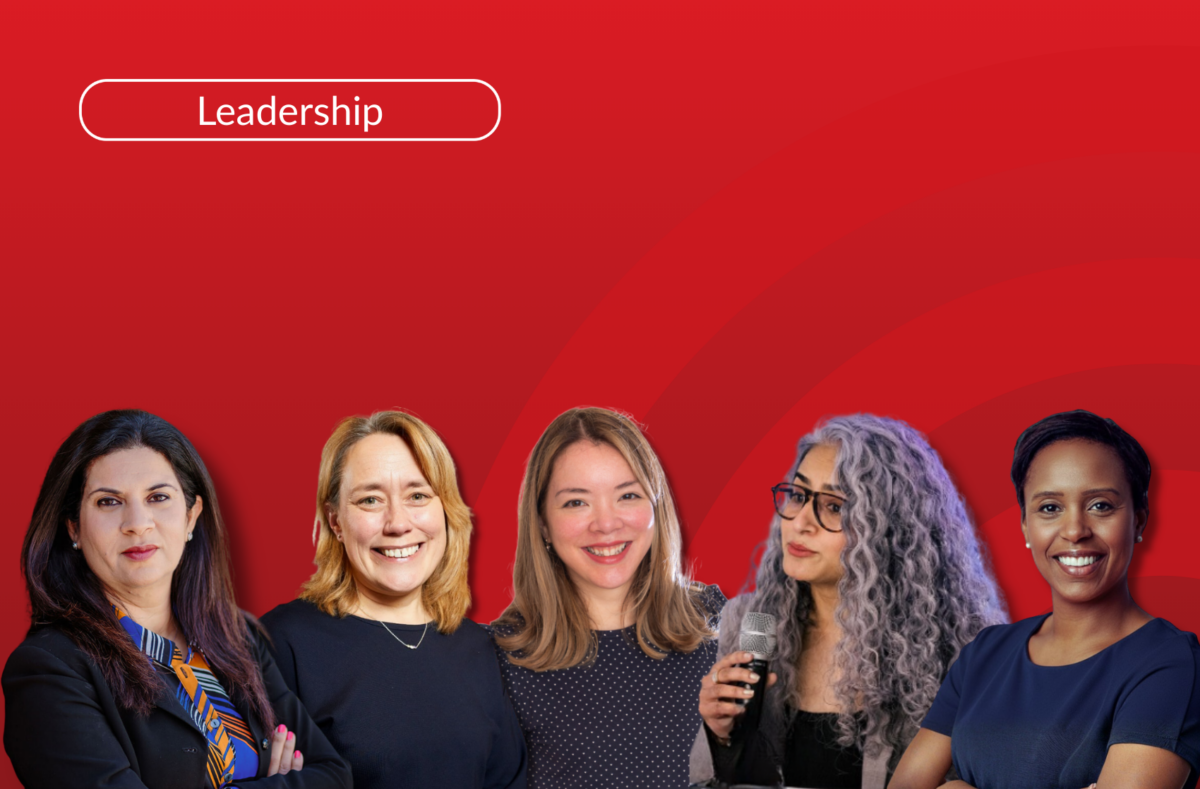
International Women’s Day invites us to pause and reflect on the leadership shaping society, not just by celebrating achievements, but by learning from the women whose work illuminates the future of public services, technology, digital trust, and sustainable innovation. Across these sectors, women are redefining how leadership can be more inclusive, equitable and forward‑thinking. Their stories offer valuable lessons for leaders at every level.
This piece draws on insights captured through previous interviews and earlier conversations with five exceptional women whose insights and impact demonstrate the breadth of leadership needed for the challenges ahead: Marteka Swaby, Professor Liz Mossop, Lucy Yu, Ritika Wadhwa and Priya Guliani.
Reframing Leadership Through Inclusion and Mental Wellbeing
Insights from Marteka Swaby
Marteka Swaby, psychodynamic psychotherapist and founder of Benevolent Health, has spent over 15 years exploring how race, gender and mental health intersect within organisational cultures. Her work, including the Kinship programme, which has supported more than 1,300 women, centres on creating psychologically safe environments where individuals can examine barriers to progression with honesty and support.
Her approach underscores a crucial leadership principle: inclusion must be actively cultivated. Women’s experiences, particularly those from underrepresented backgrounds, often reveal systemic challenges that remain invisible without intentional spaces for dialogue. Swaby’s mission to “build a bigger table” serves as an invitation for leaders to examine how their organisations recognise, elevate and sustain diverse talent.
Designing Cultures Where Women Succeed
Insights from Professor Liz Mossop
Professor Liz Mossop, Vice‑Chancellor of Sheffield Hallam University, offers a perspective rooted in experience across education, science and executive leadership. In reflecting on her career journey, she highlights the ongoing importance of leadership visibility, especially in complex or uncertain contexts, visibility that builds trust, transparency and connection.
She also emphasises that supportive organisational cultures do not emerge organically; they require deliberate effort, clear values and inclusive practice. Mossop advocates for developmental environments where early‑career women can see role models whose leadership journeys reflect their own aspirations. Her reflections reinforce that inclusive cultures are shaped through everyday behaviours, mentoring and the consistent widening of access to opportunity.
Innovating for a Sustainable and Intelligent Energy Future
Insights from Lucy Yu
Lucy Yu, CEO and Founder of the Centre for Net Zero, works at the intersection of clean energy, AI and public policy, a space where technological change and societal need converge. With two decades of experience across deep‑tech ventures and government advisory roles, Yu is recognised as one of the UK’s most influential voices in sustainable innovation.
Her research explores how AI, real‑time data and behavioural insights can be used to model smarter, more equitable energy systems. Yu’s recent appointment as the UK Government’s Clean Energy AI Champion reflects the growing importance of multidisciplinary leadership for addressing climate and energy challenges.
Her insight is clear: the energy transition is not solely an engineering challenge; it is a societal one. Future leaders must understand how technology, ethics, consumer behaviour and policy interplay to shape systems that are both sustainable and fair. Her work demonstrates how data‑driven approaches can help achieve this balance while keeping people at the heart of innovation.
Building Trust in a Decentralised Digital World
Insights from Priya Guliani
Priya Guliani, CEO of EarthID, brings a compelling perspective on digital inclusion and the future of identity. Her work champions decentralised identity, a model that aims to give individuals full control over their personal data and how it is shared. At a time when trust in digital systems is fragile and inequalities in access persist, Guliani’s leadership highlights the ethical, social and technological dimensions of identity management.
Her contributions, recognised through multiple awards including the Women in Innovation Award 2025, aim to reshape how organisations approach privacy, data security and user empowerment. Guliani’s emphasis on user‑centred design and “identity as autonomy” offers a powerful reminder: digital transformation must expand access, not deepen divides.
She also stresses the role decentralised identity could play in public services, financial access and safeguarding vulnerable communities, reinforcing that the future of digital trust depends as much on ethical leadership as on technological advancement.
Leading Through Cultural Intelligence and Human‑Centred Connection
Insights from Ritika Wadhwa
Ritika Wadhwa, founder of Prabhaav Global and a recognised authority on cross‑cultural leadership, brings a powerful lens on how cultural intelligence (CQ) shapes the effectiveness of leaders in a globally interconnected world. Her work focuses on helping leaders and organisations strengthen their ability to navigate difference, whether cultural, generational, or structural, through empathy, curiosity and conscious adaptation.
Wadhwa highlights that cultural intelligence is not simply awareness of diversity; it is the capability to work effectively across cultures through intentional behaviour, reflective practice and active listening. In her coaching and advisory work, she encourages leaders to examine their biases, develop humility, and build organisational cultures that value diverse perspectives as strategic assets.
Her insight reinforces a growing leadership truth: in a world defined by complexity, those who lead inclusively, through respect, openness and cultural agility, are better equipped to build trust, foster collaboration, and deliver impact across communities and contexts.
What These Leaders Teach Us About the Future of Leadership
Across their diverse fields, each leader demonstrates a shared set of principles that will shape the next chapter of public and civic leadership:
- Inclusion requires intentional design – not just open doors but structural support.
- Visibility strengthens trust – especially in institutions navigating complexity.
- Innovation must remain human‑centred – whether in mental health, identity, energy or education.
- Cultural intelligence strengthens leadership – enabling connection across difference.
- Equity and access are strategic priorities – not peripheral considerations.
- Diverse leadership unlocks resilience and creativity – qualities increasingly essential in a fast‑changing world.
These principles serve as a guide for organisations seeking to build cultures where women, and all underrepresented groups, can thrive and lead meaningfully.
A Moment to Learn, Reflect and Act
International Women’s Day is a celebration, but also an educational moment. The stories of Marteka Swaby, Liz Mossop, Lucy Yu, Priya Guliani and Ritika Wadhwa offer not only inspiration but critical insights for the decisions leaders make every day. They remind us that progress is not inevitable; it is shaped by those willing to challenge norms, model inclusive behaviours and design systems with equity at their core.
As the public sector and broader society continue to adapt to technological, social and environmental change, these leaders show how compassion, curiosity and courage can guide us toward a more inclusive and resilient future.