Across government, health, housing, education and the not‑for‑profit sector, boards are operating in an environment of sustained complexity: heightened scrutiny, financial constraint, transformation acceleration and rising expectations of governance. In this context, board succession can no longer be a reactive response to vacancies, but a strategic discipline that shapes organisational resilience, culture and long‑term performance. Increasingly, Nominations Committees are asking not just who is available today, but what capabilities the board will need tomorrow, and how current appointments influence the effectiveness of future decision‑making.
Drawing on pan-sector insight from active board search and succession planning processes across public life, this article brings together complementary perspectives from across GatenbySanderson:
- Mark Turner sets out the broader market and board capability trends.
- Sarah Luxford explores how digital, data, AI and cyber accountability are reshaping modern boardrooms.
- Rosemary Baylis‑West examines portfolio NED careers and impact for succession pipelines.
- Alison Sortwell provides behavioural and psychometric insight on assessing board capability, judgement and challenge beyond the CV.
GatenbySanderson bring these perspectives together, combining strategic, sector and behavioural insight to help boards and candidates think more deliberately about succession, composition and what effective governance now demands.
Portfolio NED Careers: Insights from Rosemary Baylis‑West
Rosemary Baylis‑West, Principal Consultant – Central Government and Independent Schools, shares her experience of working with NEDs in Wales and Scotland.
GatenbySanderson’s Portfolio Life in the Public Sector explores how Non‑Executive Directors are building deliberate, values‑led portfolios, balancing multiple roles across sectors, geographies and organisational maturity, rather than approaching board appointments in isolation.
For Chairs and senior leaders responsible for Board succession planning, this shift matters. The most effective NED pipelines are no longer built solely from former CEOs or single‑sector experience. Instead, boards are increasingly seeking individuals who bring:
- Breadth of governance exposure
- Cross‑sector perspective
- Transferable strategic and regulatory insight
- The capacity to balance challenge with constructive support
- The capacity to be a positive disruptor
GatenbySanderson’s current work with the Welsh Government to design a new inclusive framework for public appointments looks at the modes of attracting and assessing candidates who might bring substantial lived insight which they could integrate into public sector boards to enhance governance excellence. In this context, there is an interesting dialogue to be had nationally about how to attract the portfolio NEDs of the future and help them on their journeys of discernment, bringing together those who offer professional experience and those who contribute valuable perspectives from voluntary or community‑based work, or from lived insights as a service user or someone who has experienced inequality.
Implications for board succession planning and attracting candidates
From a board search and succession perspective, portfolio NEDs often demonstrate distinctive strengths. Many bring sharpened judgement developed through exposure to multiple governance contexts, as well as a clear understanding of how different boards operate, make decisions and hold executives to account.
Equally, there is the need for Boards to avoid group think and welcome different voices to the Board table, those who might place other Board members outside of their comfort zone or bring a different, even positively disruptive, perspective.
Layered with evolving expectations from younger generations, who increasingly seek alternatives to the traditional CV and cover letter, this has implications for how to:
- Attract candidates
- Assess high‑potential, transferable talent
- Evaluate candidates already established in portfolio careers
GatenbySanderson’s recommendations
Start early with succession planning, considering together how you want governance to look and feel in your organisation for the next 3-5 years.
Consider your organisation’s policy and strategic priorities, and the value‑add potential NEDs should bring, whether disruptive innovation, or core specialisms like digital or audit.
Support early‑career and first‑time NEDs.
Portfolio careers often begin with one well‑chosen appointment. Could the Chair, Vice‑Chair or another Board member offer mentorship? What professional development or training could you provide?
Address access considerations, both during recruitment and in-role:
- Does your process remove barriers for candidates from diverse backgrounds?
- Are you providing clarity for those unfamiliar with governance structures and language?
GatenbySanderson regularly supports clients to think through and mitigate such barriers. They recommend offering access conversations upfront and keeping these separate from the selection process. This includes discussions around how to balance NED duties with working life and family responsibilities.
Professional development matters at every stage.
Continuous learning and peer support enable NEDs to progress from one board to a broader, more impactful portfolio.
Why this matters now
Public sector and arm’s‑length bodies operate in environments defined by complexity, scrutiny and constraint. Effective boards, and the people around the table, are more important than ever, bringing:
- Anticipatory judgement
- Balanced short‑ and long‑term decision‑making
- The ability to think differently in support of innovation
When thoughtfully appointed and supported, portfolio NEDs at all stages bring fresh perspective, system‑wide insight and long‑term stability. The opportunity for governance sponsors is to build succession strategies that nurture this talent, creating boards that are not only compliant, but confident, curious and future‑ready.
Psychometric insight, behavioural trends and emerging patterns: Alison Sortwell, Principal consultant
Board Recruitment
GatenbySanderson’s work in appointing leaders to nonexecutive roles, supported by assessment and development activity has highlighted the behaviours that underpin effective board performance. To inform selection decisions, they use psychometric tools to understand leadership style and preferences. Insights from public sector profiling have shaped the Altitude Model for Non‑Executives, a framework assessing potential for these roles.
See below the GatenbySanderson’s Altitude leadership model for non‑executives, summarising the core traits and behaviours that support success on boards:
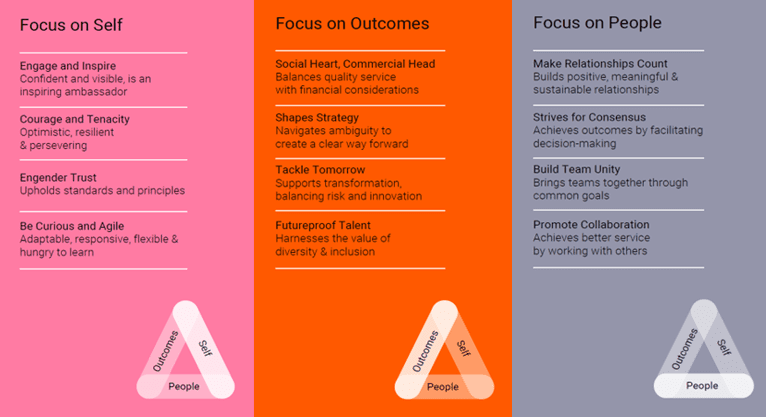
While non-executive appointments require technical expertise, the way individuals operate within the board, how they influence dynamics, decisions and outcomes, is equally critical. Given today’s complexity and uncertainty, non-executives must demonstrate adaptability, external awareness and responsiveness to shifting organisational and sector conditions.
Board evaluation
Skills audits help clarify collective board expertise and offer insight into members’ strengths and contributions. Using skills frameworks, diagnostics and independent appraisals, we evaluate both technical and behavioural competencies. These insights build a picture of board strengths and gaps, particularly valuable for informing succession planning.
Board development
Board development is most effective when approached collectively. Understanding the team’s diversity, strengths and dynamics enables boards to respond cohesively to complex challenges.
Development support may include:
- Observation
- Shadowing
- Coaching
- Workshops on board dynamics, performance and strategic effectiveness
Across all these activities, the priority is identifying the success factors of individual non-executives, and how these combine to create a high‑performing board equipped for present and future demands.
A digital and AI lens:
Insights from Sarah Luxford, Partner – Digital, Data & Technology
Modern boards are now accountable for decisions shaped by digital, data and AI just as they are for financial performance, risk and reputation. This marks a clear shift from technology as an operational concern to a core governance responsibility.
This tension is intensifying as boards oversee AI‑driven operating‑model change against a security landscape that is:
- More frequent
- More sophisticated
- More consequential
Recent high‑profile cyber breaches at organisations such as Jaguar Land Rover and M&S highlight that digital failure no longer sits within IT alone, it damages trust, brand and resilience. Across sectors, boards must now confront difficult questions about:
- How data is used
- How it is protected
- Whether cyber and AI risks are understood or simply reported
GatenbySanderson insights reinforce that boards with digital, data, AI and cyber‑literate NEDs materially raise the quality of challenge. Their role is not to “own” technology, but to:
- Model curiosity
- Ask the second question
- Help boards interrogate AI implications on customer experience
- Challenge assumptions behind cyber assurance
- Assess confidence in crisis readiness
As customer trust, service delivery and organisational resilience become inseparable from digital capability and security, boards that intentionally broaden their composition are better positioned to govern transformation with intent, not hindsight.
Closing summary by Mark Turner
As these perspectives collectively illustrate, modern governance is being reshaped by forces that demand more deliberate, forward‑looking approaches to succession, capability and board composition. Whether through the breadth and lived experience of portfolio NEDs, the behavioural insight revealed through psychometrics, or the increasingly pivotal role of digital and AI literacy in boardrooms, it is clear that effective boards cannot rely on legacy assumptions or static skillsets. The challenge, and opportunity, for Chairs and leadership teams is to build boards that combine diversity of thought, technical depth and behavioural strength, supported by rigorous, strategic succession planning.
By approaching board renewal with intention and curiosity, organisations can strengthen resilience, enhance decision‑making, and ensure their governance is genuinely equipped for the complexity of the decade ahead.
The article is written by Mark Turner, Managing Partner, Board and Central Government practice at GatenbySanderson